

Experts Vote 7–2 to Support Parental Permission for Minors Using AI Companion Platforms
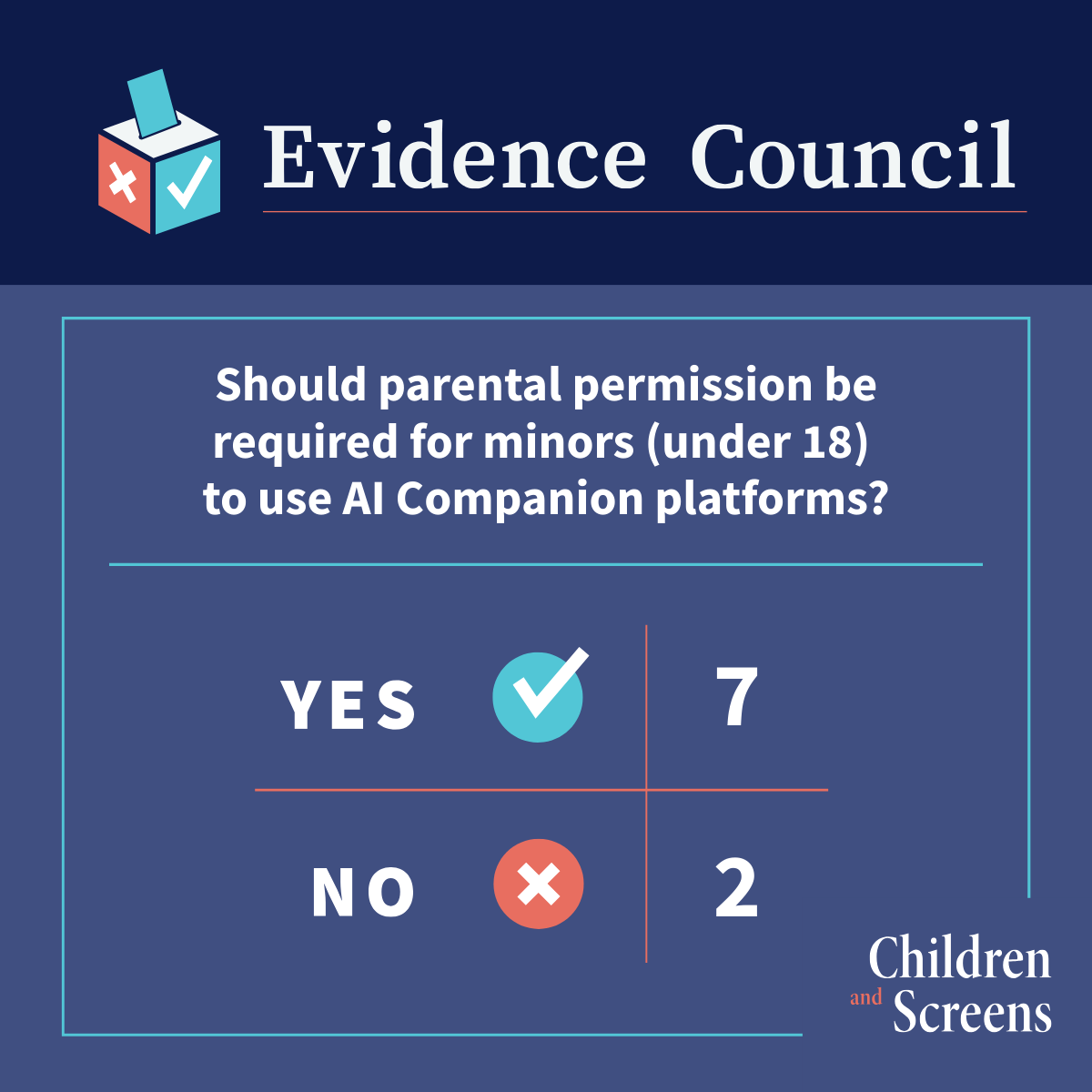
Experts Vote 7–2 to Support Parental Permission for Minors Using AI Companion Platforms
Children and Screens Evidence Council finds growing risks for youth amid rapid adoption and limited safeguards.
The use of AI companions is spreading rapidly among children and teens, yet we know remarkably little about how it may shape emotional development, social expectations, or mental health.”
NEW YORK, NY, UNITED STATES, February 17, 2026 /EINPresswire.com/ -- A strong majority of leading child development and mental health experts agree that parental permission should be required before minors use AI companion platforms, citing concerns about safety, emotional development, and the lack of proven protections for young users.— Kris Perry, Executive Director of Children and Screens
In its first vote-based position, the newly launched Children and Screens Evidence Council voted 7–2 in favor of requiring parental consent for children and teens under 18 to access AI companion platforms - software systems designed to engage users in ongoing, personalized, conversational relationships rather than perform a single task. Read the full report here and read the summary findings here.
The vote reflects growing unease among experts as AI companions become increasingly popular with youth, despite limited research on their developmental and psychological effects.
“The use of AI companions is spreading rapidly among children and teens, yet we know remarkably little about how it may shape emotional development, social expectations, or mental health,” said Kris Perry, Executive Director of Children and Screens. “This vote reflects a precautionary approach grounded in what we already know about child development and risk.”
Experts who voted in favor emphasized that children and adolescents may lack the developmental capacity to fully evaluate the risks associated with habitual AI companion use. Council members raised concerns including:
• Emotional reliance and distorted social expectations
• Exposure to sexual or inappropriate content
• Displacement of sleep, in-person relationships, and healthy social development
• Risk of harmful or dangerous advice
• Limited or inconsistent industry safeguards for youth
Several experts noted that parental permission could serve as an important safety mechanism - one that helps parents stay informed and encourages meaningful conversations about why a child wants to use an AI companion and whether it is appropriate.
“Parents sign consent forms for activities that carry far less risk,” said Dr. Dimitri Christakis, pediatrician and Council member. “Given the uncertainties and potential harms, requiring parental permission is a reasonable safeguard.”
Others emphasized that parental consent should not be seen as a substitute for stronger platform responsibility.
“Parental permission is one positive step,” said Kelly Brownell, Council member, “but it should not be used to justify corporate or government inaction.”
Two Council members voted against a blanket parental-permission requirement, cautioning that overly rigid rules could have unintended consequences.
Dissenting members raised concerns that such policies could:
• Reduce trust or encourage secretive use
• Disadvantage marginalized youth who may need private spaces to explore sensitive issues
• Be misaligned with age thresholds used in other digital contexts
They emphasized alternatives such as graduated access, strong default safeguards, and structured parent-child dialogue - particularly for older adolescents.
Council members across the vote agreed on one key point: requiring parental permission alone is not a complete solution.
While empirical research on AI companions is still emerging, experts emphasized that real risks already exist, warranting precaution alongside continued study, improved platform design, and greater transparency.
The Evidence Council’s position does not advocate for specific laws or products. Instead, it provides an evidence-informed foundation to help parents, educators, journalists, and policymakers understand where expert consensus exists - and where important questions remain open.
“Our goal is clarity, not oversimplification,” Perry added. “Families deserve guidance that reflects both what the science shows and where uncertainty remains.”
More information about the Evidence Council is available at www.childrenandscreens.org.
About the Children and Screens Evidence Council
The Children and Screens Evidence Council is a new initiative composed of leading researchers and clinicians from the Institute’s National Scientific Advisory Board. The Council issues concise, vote-based evidence statements on major questions affecting children’s digital lives, offering transparent insight into expert agreement and disagreement. Each position includes the vote outcome, key scientific considerations, and individual expert rationales.
About Children and Screens
Children and Screens is an independent, non-profit organization dedicated to advancing and supporting research, informing policy, and educating the public about children’s digital media use and its impact on cognitive, psychological, social, behavioral, and physical development.
Jon Bleicher
Prospect PR
+1 973-330-1711
email us here
Legal Disclaimer:
EIN Presswire provides this news content "as is" without warranty of any kind. We do not accept any responsibility or liability for the accuracy, content, images, videos, licenses, completeness, legality, or reliability of the information contained in this article. If you have any complaints or copyright issues related to this article, kindly contact the author above.
